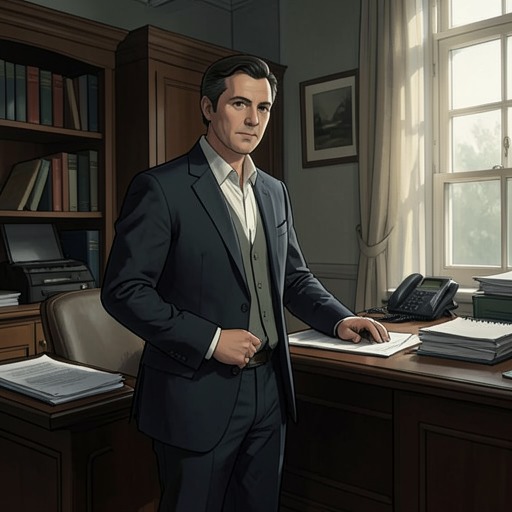
Lindy Briggs
Bag of BonesLindy Briggs is a librarian in the Dark Score Lake community whose knowledge helps Mike Noonan pursue two interwoven lines of inquiry: the history of the place where he lives and the pressure surrounding Mattie Devore’s custody case. She offers access to local books, identifies what their accounts leave out, and quietly passes along information about the investigation. Her role is modest in scale but consequential in method: she stands at the threshold between public records, local knowledge, and the guarded disclosures that make a fuller history possible.
Identity and Work
Lindy works at the library and handles ordinary public-facing duties, including renewing Mike’s card and entering his details into the library’s computer. When Mike returns to the library after Jo’s death, Lindy expresses sympathy, though he senses reproach in the delay of his condolences. Their exchange establishes a strained but functional relationship: grief is acknowledged, while the local community’s judgments remain present beneath the routine transaction.
Lindy knows the library’s holdings and their limitations. When Mike asks for a town history, she says the library has two and confides that neither is much good. She nevertheless recommends the better of them, Edward Osteen’s privately published Dark Score Days, written in 1965 or 1966. Osteen had been a summer resident and later lived in the area full-time after retiring. Commercial and regional publishers had declined the book; local residents bought copies, but Lindy doubts the circulation was large.
Mike’s Historical Inquiry
Lindy distinguishes the book’s research value from its literary shortcomings. In her view, Osteen was a poor writer and photographer, and his small black-and-white pictures were difficult to look at. Yet the book contains stories worth knowing, including the Micmac Drive, General Wing’s trick horse, an 1880s tornado, and the fires of the 1930s. Her description helps Mike approach the volume not as a reliable or complete account, but as a flawed source that may preserve material absent elsewhere.
When Mike asks whether Osteen wrote about Sara and the Red-Tops, Lindy confirms that the book includes an old photograph, which Osteen believed had been taken at the Fryeburg Fair in 1900. She also recalls that he wished he could hear a record made by the group. This brief lead directs Mike toward evidence of Sara and the Red-Tops’ presence in local history, but it does not resolve what happened to them or how accurately their story was recorded.
The limitations become clearer when Mike reads Osteen’s account. He finds that its two-page treatment labels the group a “Dixie-Land octet,” although Sara and the Red-Tops primarily performed blues on Friday and Saturday nights and gospel on Sunday mornings. Osteen’s account is thin, and it does not appear to reflect other performers’ versions of Sara’s songs. Lindy’s candid assessment therefore anticipates the problem Mike encounters: the available town history preserves fragments, but its errors and omissions make it inadequate as a full record.
Custody Case and Quiet Disclosure
Lindy also becomes an indirect source of information in the custody dispute surrounding Mattie and her daughter, Kyra. In February, she tells Mattie that George Footman had visited the library to inspect the fire extinguishers and smoke detectors. He also asked whether Lindy had noticed beer or liquor containers in the trash, or cigarette butts that appeared homemade. The questions suggest that someone was looking for evidence of conduct that might damage Mattie’s position, although the exchange does not establish what, if anything, was found.
Mike later encounters Lindy at the library while Mattie is present. Lindy is watching them from the main desk, and her welcoming smile disappears as their conversation draws her attention. Mattie takes the books to reshelve and uses the moment to tell Mike that his lawyer had arranged for John Storrow to have a private detective. The detective may have found something interesting about the guardian ad litem. Lindy does not herself reveal the suspected discovery; her watchfulness and the discreet setting frame the disclosure as information that cannot safely be discussed openly.
The Gaps in the Record
Lindy’s place in the story gains significance through contrast with Jo Noonan’s later-discovered research. Jo had begun her inquiry as research for an article, initially treating it as a lark: she read books, spoke with residents, listened to old stories, and encouraged people to look for letters and diaries. Her investigation eventually relied on scattered sources rather than a single authoritative local account. Lindy’s library contains the published histories Mike first consults, while Jo’s work reaches toward testimony and private materials the histories do not adequately preserve.
The distinction is sharpened when Mike finds Jo’s hidden papers. They include dated photocopies of newspaper clippings, one reaching back to 1865, as well as notes and other materials. The clippings about Sara and the Red-Tops adopt a tone of genial contempt, describing the Black musicians through racist caricature even when presenting favorable reviews. The surviving town histories, meanwhile, do not disclose the circumstances behind the group’s departure. Jo’s notes preserve the account that by the group’s final Castle County performance in September 1901, many local residents knew Sara and her son had been murdered and had suspicions about the perpetrators, while the community increasingly closed ranks against the Red-Tops.
Lindy does not author or uncover Jo’s archive, and the evidence does not make her responsible for the omissions in the town histories. Her significance lies in the intermediary position she occupies: she can point Mike toward the books and stories the library does hold, while the inadequacy of those records makes clear why Jo’s independent investigation matters. Through that contrast, the library becomes both a resource for historical inquiry and a measure of what public local memory has failed to retain.